
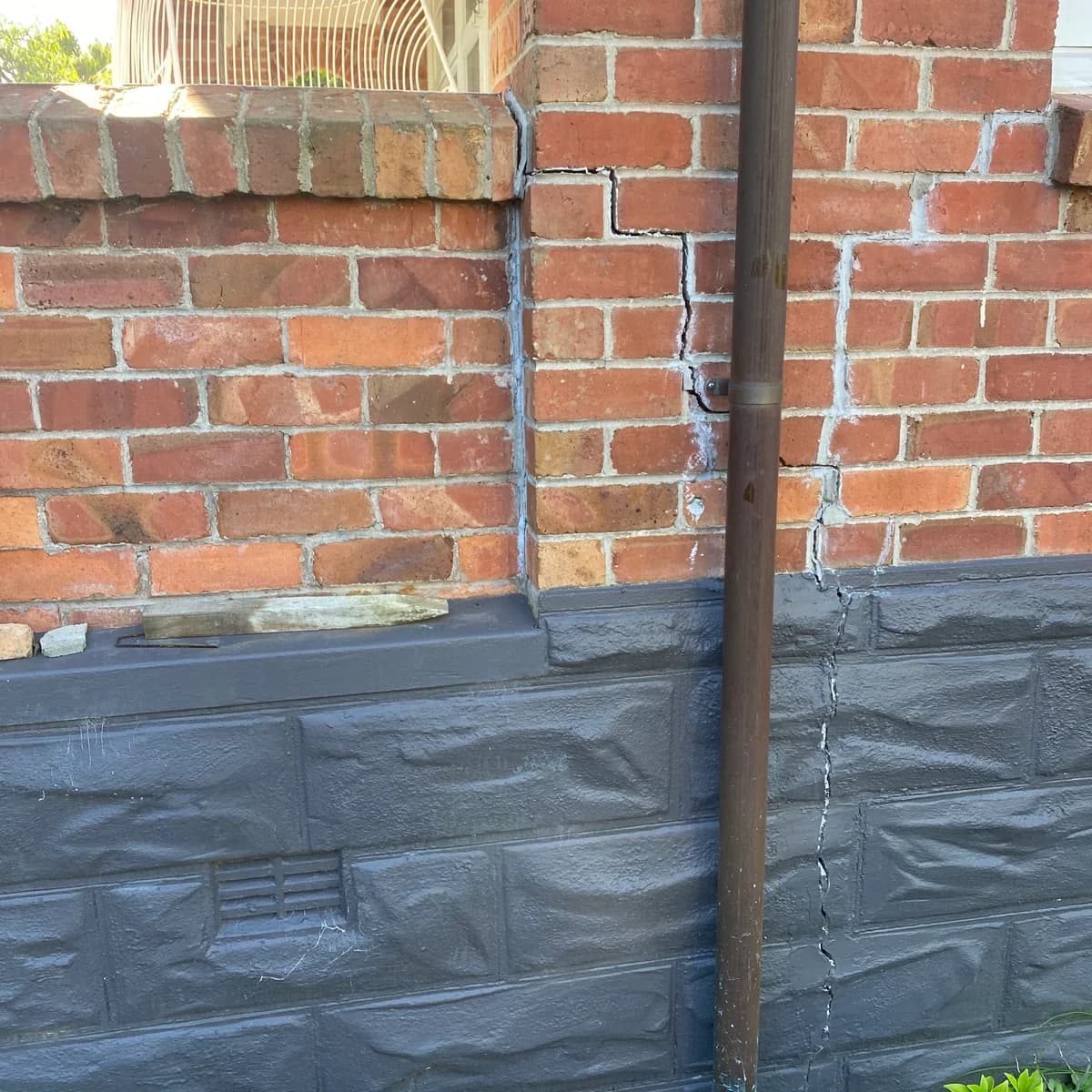
A stepped crack — one that zigzags up a brick or block wall following the mortar joints like a staircase — is a recognisable pattern that can be associated with building or foundation movement. It's also the crack type people most often photograph and send me.
Why cracks step
Mortar is weaker than brick, so when the foundation beneath a wall moves unevenly, the crack takes the path of least resistance: along the joints. The staircase shape is the wall accommodating differential movement — one part of the foundation dropping (or lifting) relative to another.
Movement may be relatively uniform or differential, and only an appropriate assessment can determine its significance for a particular structure.
Common causes in NZ homes
- Clay shrink/swell — common on clay soils across NZ: dry summers shrink clay, foundations follow it down at the driest corner.
- Drainage and moisture — record broken downpipes, blocked drains, or water pooling near the area as possible context, without assuming causation.
- Fill and reclaimed ground — parts of many NZ suburbs sit on fill that consolidates for decades. Particularly older suburbs and houses in low-lying areas: older low sites were often backfilled or levelled off before the house went on, and older homes had no requirement to accommodate differing site conditions — many sit on non-engineered fill.
- Tree roots drying the soil on one side of the house.
- Undersized or deteriorating foundations on older homes.
- Large public utility lines beneath or nearby — water mains, sewer and stormwater lines were laid in large open trenches. Even when constructed properly, trench backfill can and very often will settle over time, taking any structure close by or on top of it along for the ride.
- Seismic movement — new stepped cracks after a shake need their own checklist. → cracks after an earthquake
How serious is it?
Honest answer: it ranges from “monitor it” to “worth a prompt inspection,” and the crack alone doesn't tell you which. What shifts my read:
- Width and taper. A hairline step that's uniform top to bottom is milder than a crack that's wider at the top (rotating wall) or wider at the bottom.
- Fresh edges. Clean, sharp, unweathered edges = recent movement. Paint or dirt inside the crack = it's been there a while.
- Location. Above a window on a ring foundation corner is a different story than mid-wall on a garden wall.
- The rest of the house. Doors, floors, other cracks — a stepped crack rarely acts alone if the movement is significant. → sticking doors and uneven floors
What to do, in order
- Photograph it today: wide shot, close-up with a coin or tape for scale, and the ground/drainage below it.
- Record nearby water conditions. Photograph downpipes, drainage, and any pooling without assuming they caused the crack.
- Get suitable advice. A screening report can organise the evidence, while a qualified on-site professional can assess cause, stability, and repair options.
- If monitoring is appropriate: use a consistent, dated method and an interval suited to the circumstances or professional advice.
- Escalate promptly if it's widening, if doors nearby are moving, or if the wall shows any lean.